Korean outside the classroom

Learn Korean across a board

In Korea, four board games are part of ordinary life: you play them with a grandfather, in a school corridor, in a park, on a phone on the subway. They are also one of the easiest places to use Korean with real people, because a game gives you something to say.

Why a game is good Korean practice

The same words, over and over

A game has a small vocabulary โ€” black, white, your turn, one more, well played โ€” and you meet all of it in every game. That is exactly how words stick.

A reason to say something

Talking to a stranger is hard when you have nothing to talk about. Across a board you always do: greet, ask for one more game, say it was fun.

Short, low-pressure turns

Nobody expects a long sentence in a game chat. One phrase you learned here is a complete, natural message.

The four games

Gomoku.com

Omok โ€” five in a row

์˜ค๋ชฉ omok

The first board game most Korean children learn.

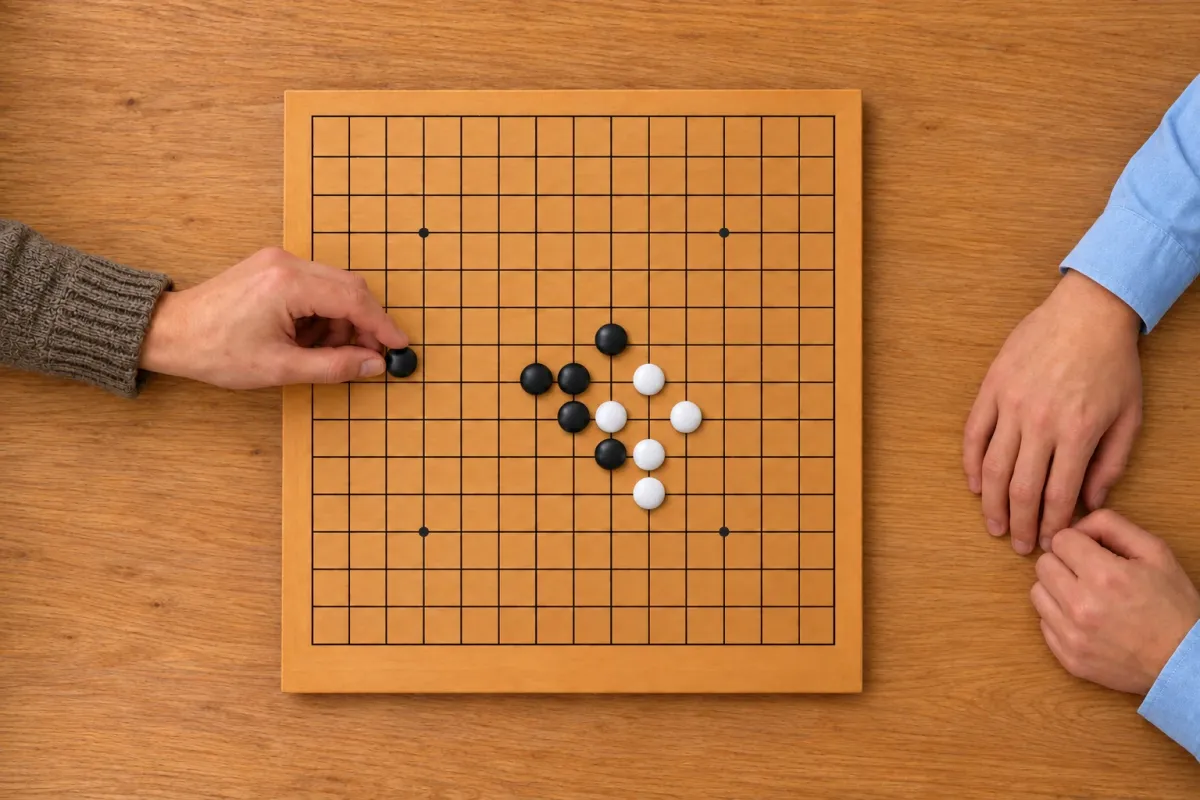
Two players take turns putting black and white stones on the crossings of a board. The first to line up five in a row โ€” across, down or diagonally โ€” wins. A game takes a few minutes and the rules take one.

Korean pupils often play it on squared notebook paper at their desks. The name is the number you learned in the numbers lesson: ์˜ค, five, plus ๋ชฉ, a point on the board.

  • 15 ร— 15 board, black moves first.
  • Play the computer at four levels, or a person online; there are private rooms you can share by link.
  • The game room has a text chat, so this is a place to try the phrases below.

Every button and message in Korean โ€” reading practice while you play.

A wooden five-in-a-row board seen from above with a handful of black and white stones near the centre; two players' hands at the edges.
Omok is played on the crossings of the lines, not inside the squares.
Diagram. Black has four in a row with both ends open. White can block only one end, so black wins on the next move.

Korean you will meet

  • ์˜ค๋ชฉomok ยท omok โ€” five in a row (gomoku)From the characters ไบ”็›ฎ, โ€œfive pointsโ€. ์˜ค is the number five you already know.
  • ๋Œdol ยท stoneA baduk stone is ๋ฐ”๋‘‘๋Œ.
  • ํ‘heuk ยท black (the black stones)Black moves first in omok and baduk.
  • ๋ฐฑbaek ยท white (the white stones)Sounds exactly like ๋ฐฑ โ€œhundredโ€.
  • ํŒpan ยท a game, a round; also the boardํ•œ ํŒ = one game. The board is ๋ฐ”๋‘‘ํŒ or ์žฅ๊ธฐํŒ.

BadukGo.com

Baduk โ€” the game of Go

๋ฐ”๋‘‘ baduk

Simple rules, a lifetime of depth, and a national passion.

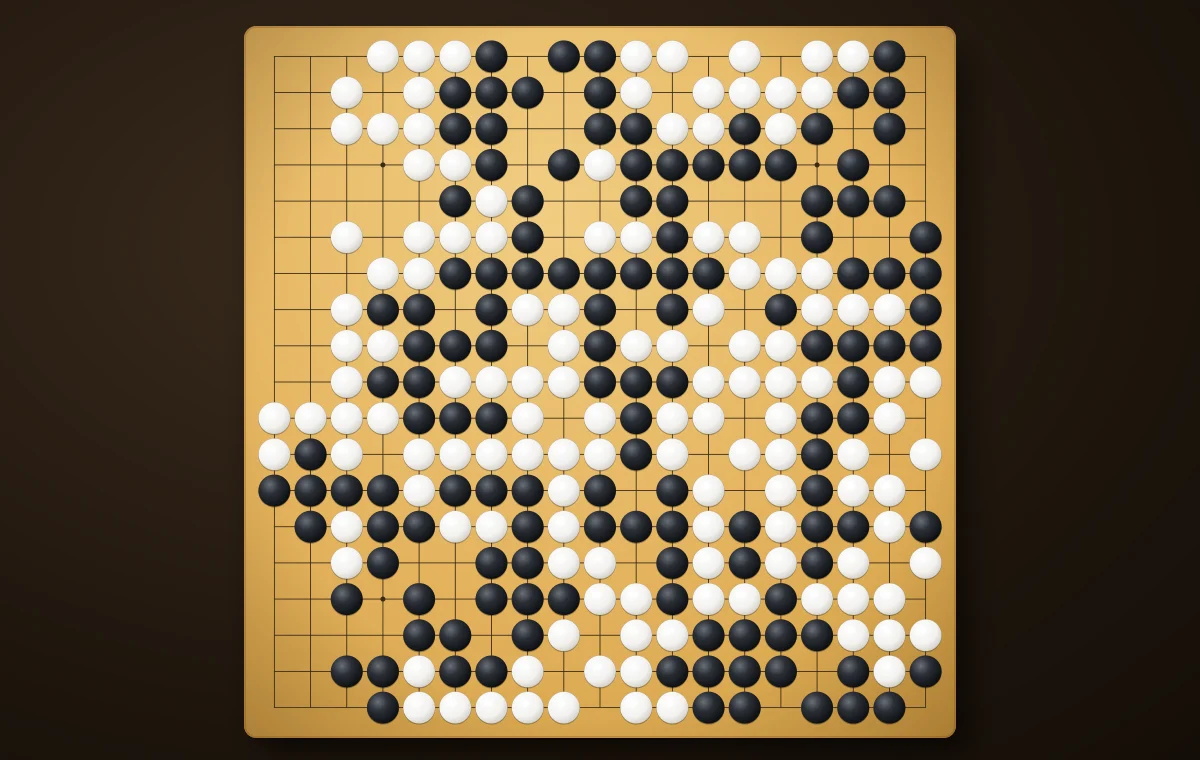
The stones are the same as in omok, but the aim is different: you surround empty points to make territory, and capture stones by taking away their last free neighbouring point. Korea has produced many of the world's strongest players, and professional games are shown on television.

Baduk Korean is everyday Korean used in a special way: territory is ์ง‘, โ€œhouseโ€, the word you already know. The points White receives for moving second are ๋ค โ€” the little extra a market seller throws in.

  • Boards of 9, 13 and 19 lines; Korean rules, with 6.5 points of ๋ค for White.
  • A step-by-step tutorial on a small board, three computer levels, and online games against people.
  • Text chat in the game room and private messages between members.

Every button and message in Korean โ€” reading practice while you play.

A full 19 by 19 baduk board late in a game, densely covered with black and white stones.
A finished game on the full board. Beginners start on 9 lines.
Diagram. The white stone has one free point left (marked). That is ๋‹จ์ˆ˜. If black plays there, the stone is captured.

Korean you will meet

  • ๋ฐ”๋‘‘baduk ยท baduk โ€” the game of Go
  • ์ง‘jip ยท territory (in baduk)The same word as โ€œhouseโ€: the points you surround are your houses.
  • ๋‹จ์ˆ˜dansu ยท atari โ€” one move from being captured
  • ๋คdeom ยท komi โ€” points given to White for moving secondIn everyday Korean ๋ค is a little extra thrown in for free at a market.
  • ์ดˆ์ฝ๊ธฐchoilgi ยท byo-yomi โ€” the countdown when your main time is goneLiterally โ€œreading secondsโ€.

JanggiOnline.com

Janggi โ€” Korean chess

์žฅ๊ธฐ janggi

The game you see being played on park benches.

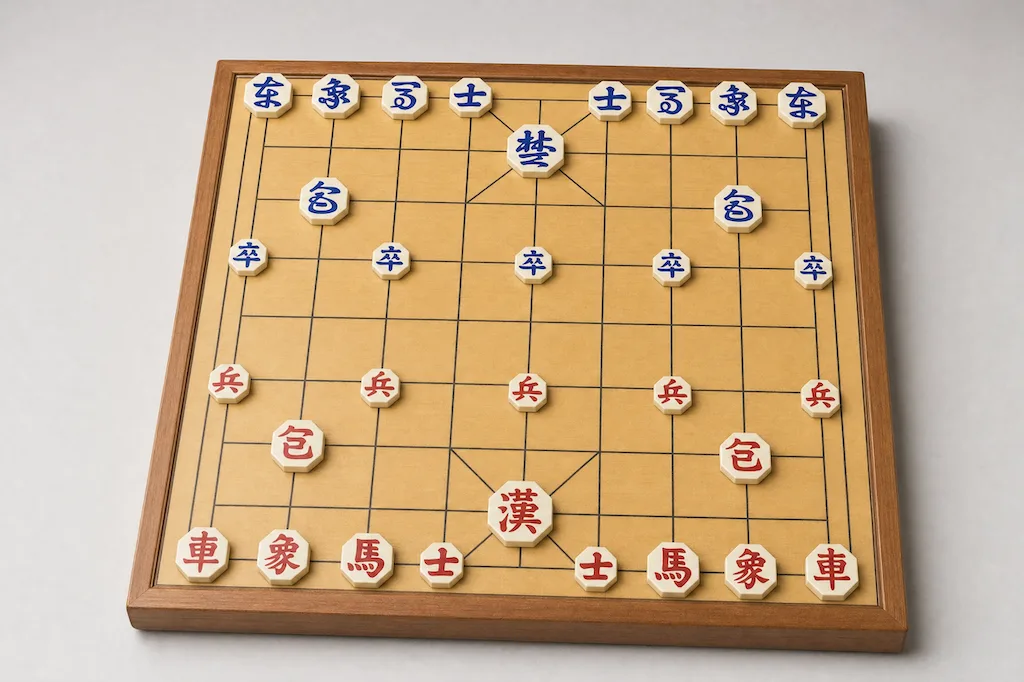
Two armies, Cho (blue) and Han (red), face each other on a board of nine lines by ten. Each general stays inside a small palace; you win by trapping the other one. Chariots run in straight lines, horses and elephants step and turn, cannons must jump over a piece to move.

The pieces are marked with Chinese characters, but players name them in Korean, one syllable each: ์ฐจ, ํฌ, ๋งˆ, ์ƒ, ์‚ฌ. When you attack the general you call out ์žฅ๊ตฐ! โ€” and the answer is ๋ฉ๊ตฐ!

  • 9 ร— 10 board, sixteen pieces each. Cho, the blue side, moves first.
  • An interactive tutorial teaches each piece; then play the computer at four levels or people online.
  • You hear the calls in Korean โ€” ์žฅ๊ตฐ, ๋ฉ๊ตฐ โ€” whichever language the site is in. The game room has a text chat.

Every button and message in Korean โ€” reading practice while you play.

A janggi board in the starting position: blue pieces of Cho at the top, red pieces of Han at the bottom, each general in its palace.
The starting position. The generals, ๆฅš and ๆผข, sit in the middle of their palaces.
ๆผขๅฃซๅฃซ้ฆฌ่ฑก
Diagram. The palace: nine points joined by diagonals. The general (๊ถ) and the two guards (์‚ฌ) may not leave it.

Korean you will meet

Mark on the pieceKorean namePiece
ๆผข / ๆฅš๊ถ gungthe general (the piece you must protect)
่ปŠ์ฐจ chachariot
ๅŒ…ํฌ pocannon
้ฆฌ๋งˆ mahorse
่ฑก์ƒ sangelephant
ๅฃซ์‚ฌ saguard
ๅ…ต๋ณ‘ byeongsoldier (Han, the red side)
ๅ’์กธ jolsoldier (Cho, the blue side)
  • ์žฅ๊ธฐjanggi ยท janggi โ€” Korean chess
  • ์žฅ๊ตฐ!janggun! ยท Check!Literally โ€œGeneral!โ€. Said when you attack the other side's general.
  • ๋ฉ๊ตฐ!meonggun! ยท the reply to ์žฅ๊ตฐ: โ€œI have answered your checkโ€

Alkkagi.com

Alkkagi โ€” flick the stones

์•Œ๊นŒ๊ธฐ alkkagi

What Korean children do with a baduk set when no one is looking.

Each player lines up a few stones on a board and takes turns flicking one with a finger. Knock an opponent's stone off the edge and it is out; lose your own over the edge and that is out too. The last side with stones on the board wins.

It needs no reading and no strategy books, which is why it is a favourite at family gatherings โ€” and a relaxed way to play with someone when your Korean is still small.

  • Classic game with 5 to 10 stones a side, plus versions played with janggi pieces.
  • Two players on one device, against the computer, or online with an invitation link.
  • There is no chat on this one: it is a game to play side by side, or while talking on a call.

Every button and message in Korean โ€” reading practice while you play.

Diagram. Flick your own stone so that it knocks the other side's stone over the edge โ€” without following it off the board.

Korean you will meet

  • ์•Œ๊นŒ๊ธฐalkkagi ยท alkkagi โ€” flicking stones off the board์•Œ is a small round thing (also โ€œeggโ€); the game is played with baduk stones.
  • ๋Œdol ยท stoneA baduk stone is ๋ฐ”๋‘‘๋Œ.
  • ํŒpan ยท a game, a round; also the boardํ•œ ํŒ = one game. The board is ๋ฐ”๋‘‘ํŒ or ์žฅ๊ธฐํŒ.
  • ํ•œ ํŒ ๋” ํ•ด์š”han pan deo haeyo ยท Let's play one more

What players say

These are complete messages. Type one into a game chat, or say it to the person across the table.

Before the game

  • ํ•œ ํŒ ํ• ๊นŒ์š”?han pan halkkayo? ยท Shall we play a game?
  • ์ž˜ ๋ถ€ํƒ๋“œ๋ฆฝ๋‹ˆ๋‹คjal butakdeurimnida ยท I look forward to a good game

During the game

  • ์ฒœ์ฒœํžˆ ํ•˜์„ธ์š”cheoncheonhi haseyo ยท Take your time
  • ์ž ๊น๋งŒ์š”jamkkanmanyo ยท Just a moment
  • ์žฅ๊ตฐ!janggun! ยท Check!
  • ๋ฉ๊ตฐ!meonggun! ยท the reply to ์žฅ๊ตฐ: โ€œI have answered your checkโ€

When it ends

  • ์ž˜ ๋‘์…จ์–ด์š”jal dusyeosseoyo ยท Well played
  • ์ˆ˜๊ณ ํ•˜์…จ์Šต๋‹ˆ๋‹คsugohasyeosseumnida ยท Good game โ€” thank you for playing
  • ์ œ๊ฐ€ ์กŒ์–ด์š”jega jyeosseoyo ยท I lost
  • ์ œ๊ฐ€ ์ด๊ฒผ์–ด์š”jega igyeosseoyo ยท I won
  • ๋ฌด์Šน๋ถ€์˜ˆ์š”museungbuyeyo ยท It's a draw
  • ํ•œ ํŒ ๋” ํ•ด์š”han pan deo haeyo ยท Let's play one more

Saying who you are

  • ํ•œ๊ตญ์–ด๋ฅผ ๋ฐฐ์šฐ๊ณ  ์žˆ์–ด์š”hangugeoreul baeugo isseoyo ยท I'm learning Korean
  • ์ €๋Š” ํ•œ๊ตญ์–ด ์ดˆ๋ณด์˜ˆ์š”jeoneun hangugeo choboyeyo ยท I'm a beginner at Korean
  • ์–ด๋””์—์„œ ์˜ค์…จ์–ด์š”?eodieseo osyeosseoyo? ยท Where are you from?
  • ์ฒœ์ฒœํžˆ ๋งํ•ด ์ฃผ์„ธ์š”cheoncheonhi malhae juseyo ยท Please speak slowly
  • ์žฌ๋ฏธ์žˆ์—ˆ์–ด์š”jaemiisseosseoyo ยท That was fun
  • ๋˜ ๋งŒ๋‚˜์š”tto mannayo ยท See you again

Check the words

Eight quick questions on the game words above.

How to use a game as practice

  1. Learn the game in your own language first. You cannot practise Korean while also working out how a horse moves. Play a few games against the computer until the rules are automatic.
  2. Switch the site to Korean. Now every label is a word you can guess from where it sits: start, resign, one more game, your turn. This is reading practice that costs no effort.
  3. Open with one phrase. When you are matched with someone, type ์ž˜ ๋ถ€ํƒ๋“œ๋ฆฝ๋‹ˆ๋‹ค. If they answer in Korean, add ํ•œ๊ตญ์–ด๋ฅผ ๋ฐฐ์šฐ๊ณ  ์žˆ์–ด์š”. Most people are kind to a learner who says so.
  4. Close properly. Win or lose, end with ์ˆ˜๊ณ ํ•˜์…จ์Šต๋‹ˆ๋‹ค or ์ž˜ ๋‘์…จ์–ด์š”. It is what Korean players say to each other, and it is good manners in any language.

Good manners at the board

  • Greet at the start and thank at the end. Leaving without a word is rude everywhere.
  • Use the polite endings you have learned, even if the other person writes casually. A learner being polite is never wrong.
  • Not everyone you meet online is Korean, and not everyone wants to chat. If there is no answer, just play.
  • Never share personal details in a game chat.

A note about these four sites. Gomoku.com, BadukGo.com, JanggiOnline.com and Alkkagi.com are run by the same team as KoreanSchool.com. We recommend them because we know exactly what is in them; you can of course practise the same phrases on any board, online or on a table.

Not reading Hangul yet?

The names on this page are easier once you can read them. The first lesson takes five minutes.

Start lesson 1